Managed graphs
Inspect saved work relationships, source-version checks, revisions and review decisions.
The graph is a working map of evidence and results. It must help a person find what changed, understand the affected work and review the next action. A larger or more animated drawing does not meet this requirement by itself.
Two connected views
Work relationships shows records saved by the local worker: sources, source versions, runs, reports, revisions, saved checks and proposals. Code indexes shows the nodes and relationships recorded by a configured code index. These views have different evidence and access rules. A code path does not prove that a report used that code. Link the two only when a run records that dependency.
The current managed work implementation is under integration. It projects the local Work database. It does not extract new claims, run an indexer or infer new relationships. See maintained work for the implemented API and source access for saved code index limits.
Read the map
| Record | Meaning |
|---|---|
| Source | A tracked file with an access state and latest observation |
| Source version | The content version recorded as evidence for saved work |
| Run | A durable task and its actual progress state |
| Report | A saved result with one accepted revision |
| Revision | One stored version of the result, including its dependencies |
| Saved check | A verification record stored with a revision or proposal |
| Proposal | A specific repair or restore awaiting review, or its recorded outcome |
Each relationship names its meaning. The inspector must explain the stored record behind it. Direction matters: a dependency points to the version used; the inverse view finds records that depend on that version. A path means that those recorded relationships connect. It does not establish causation, semantic truth or the completeness of the dependencies.
The user can search, filter by record type and state, select a record, follow its relationships and open the matching Work result or review. A searchable, keyboard-accessible list provides the same record details. On a phone, opening the inspector must preserve the current filter and selection.
Freshness and control
Show source observation time separately from saved check time. A saved version can differ from the latest source without being inaccessible. Changed, missing and removed-access states must remain distinct. A restored revision retains its original check time. It does not become newly checked because it was restored.
Current source reports compare source versions. They do not independently prove statements in those sources. Saved check records must use that precise scope. Future semantic checks need their own evaluator identity, method, version, inputs, result and limits. A document or workflow cannot certify itself.
The graph opens existing review flows. It does not approve a change. Applying a repair or restore still requires the exact proposal and a fresh authorization and source check. An expired or superseded proposal remains history and cannot be applied. Failed changes leave the accepted result intact.
Removed source access must also remove cached source labels, excerpts, hashes, check details and source-dependent relationships from new responses. The UI must clear an old inspector when refreshed records are no longer visible. Previously delivered information cannot be recalled from a person's memory or an export. Graph search and counts must not reveal hidden source information.
Managed size and incomplete data
Return a bounded view with a snapshot identifier, observation time, scope and limits. Show when records were omitted. Never present a limited view as the full workspace graph. Every returned edge must have both endpoints in the response. Search and downstream focus describe the loaded view unless the server performs a wider, explicitly bounded query.
Use a spatial node-link network with compact circular nodes and visible links. The relationships determine the layout. Do not substitute rows of cards, phase columns or an architecture diagram for this view. The network occupies the main workspace; concise filters and the optional inspector support exploration.
Explain each visual encoding. Node size can show its connection count within the returned graph. Colours must have a visible legend. Spatial proximity alone does not prove a semantic relationship or a detected community. Do not invent community labels or confidence from the layout.
Support fit, pan, zoom, node dragging and connection highlighting. Preserve selection and surviving node positions across refresh where practical. Settle the layout instead of making it drift continuously. Respect reduced motion and stop background work when the view is closed. Loading, empty, denied, offline, stale, failed and recovery states need clear text and a useful next action.
The network uses a bounded force layout over the returned records and links. Colours show record types. Node size shows the number of distinct connected records in the loaded view. These are not confidence scores or semantic communities. Selecting a node highlights its neighbours and directed links; the inspector retains the full labels and recorded relationship names.
Layout calculation belongs in a locally bundled worker. It must not freeze the interface or continue after the graph is hidden or closed. The worker must load from the application's own static assets. Do not add a remote script or relax the content security policy to load it. The list remains available if the worker cannot load.
Full release target
The completed product extends these records across approved source types, explicit claims, code symbols, independent checks, workers and deliverables. It supports change history, affected-result review, controlled repairs and portable result records. Resource grants must apply to every traversal and delivery, including remote and MCP access. These are release requirements; the current local projection does not establish them.
Keep extracted relationships separate from inferred ones. Store the extraction or inference method and version. Never invent a confidence percentage without a calibrated method. Keep unresolved references visible as unresolved, and explain missing or unsupported index formats. Discovery must not grant access.
Comparison with Graphify
The target is a more useful and better managed product. Superiority remains unproven until comparable tests pass. Graphify already documents node search, paths, edge provenance, communities and pull-request impact tools. Its tutorial also documents incremental updates, watch mode and a Git hook. Use those real capabilities as the baseline. Graphify MCP tools, Graphify tutorial.
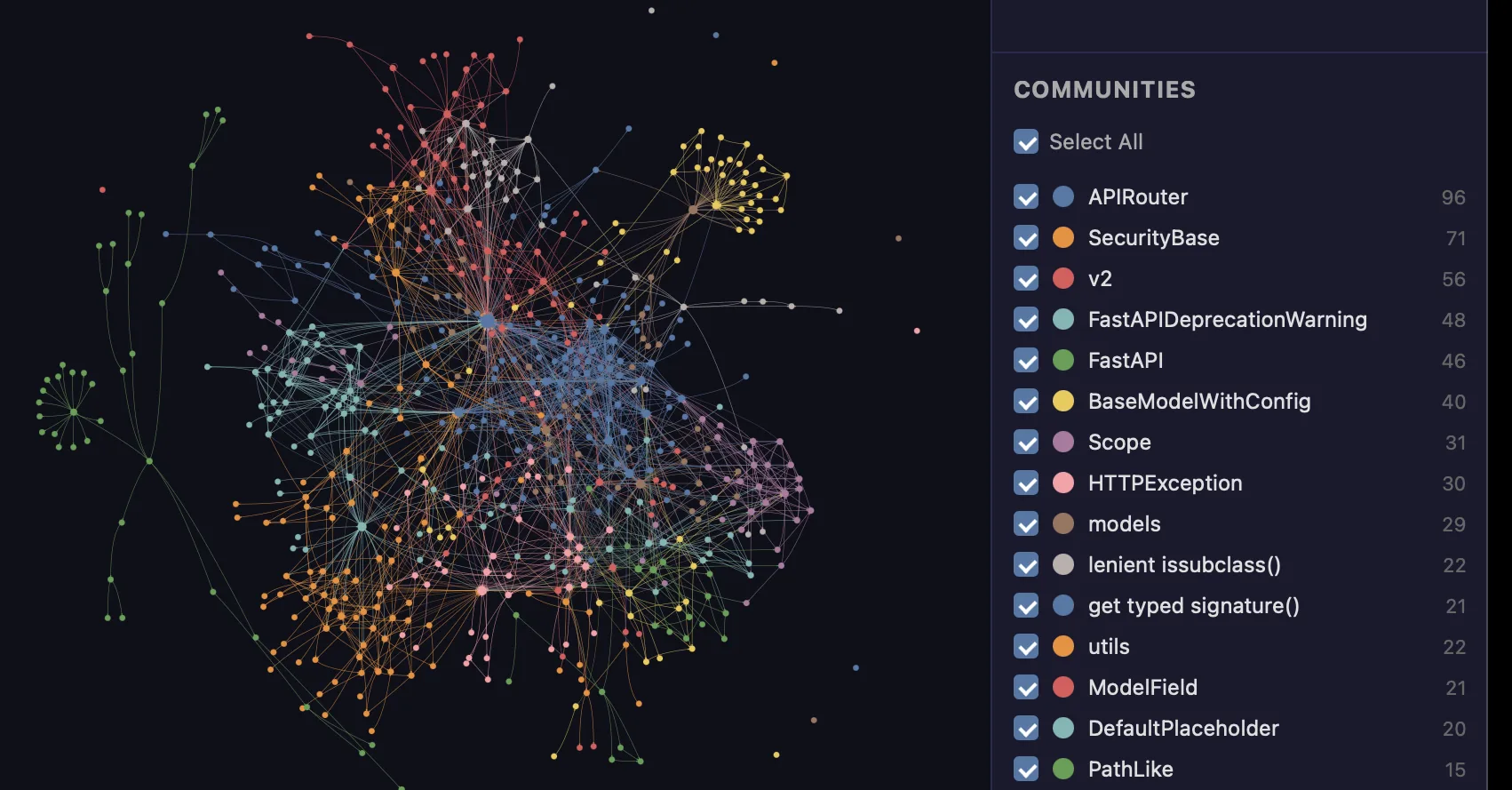
The visual reference is Graphify's published FastAPI network: compact symbol nodes, thin links, larger connection hubs and a community filter panel. An architecture diagram does not satisfy this interface requirement. Published FastAPI graph.
The source inspected on 8 September 2026 was Graphify's v8 branch at
67f99bd0059dd1bac9e44382907ef9f10098b39f. Its package version is 0.9.56;
the changelog still labels that version unreleased. This is a source reference,
not an installed or qualified adapter. Pin an actual source revision and
dependency lock for each comparison run. Inspected commit.
Brainlyy's differentiation hypothesis is the complete sequence: changed evidence, affected results, a proposed repair, independent checks and a controlled update. Version links and a graph drawing alone do not prove an advantage. The delivery targets require held-out tasks, comparable resources and published evidence before a competitive claim.
Use the following graph measures within that evaluation. Keep development fixtures out of the held-out set.
| Scenario | Measure |
|---|---|
| Find and explain a relationship | Correct endpoints, direction, provenance and unsupported-edge rate |
| Change, rename or delete evidence | Affected-result precision and recall; time until stale state is visible |
| Repair or restore a result | Correct accepted result, unchanged unrelated work, time and total cost |
| Revoke access or expire approval | Unauthorized disclosure or effects; stale inspector and cache handling |
| Large, disconnected or cyclic graphs | Response size, memory, latency, cancellation and truthful omissions |
| First use and accessible inspection | Task success, assistance needed, keyboard and mobile completion |
Record tool versions, model versions, inputs, permissions, hardware, budgets, timeouts and every unsuccessful run. Compare against full reruns and the strongest relevant supported competitor workflow. Report an unsupported task as unsupported; do not convert it into a fabricated success or silently omit it. Use a common task subset for direct quality claims and report coverage separately. Report category results and uncertainty alongside the aggregate improvement. Any unauthorized effect blocks release regardless of the average score.